
L.L. “Red” Males
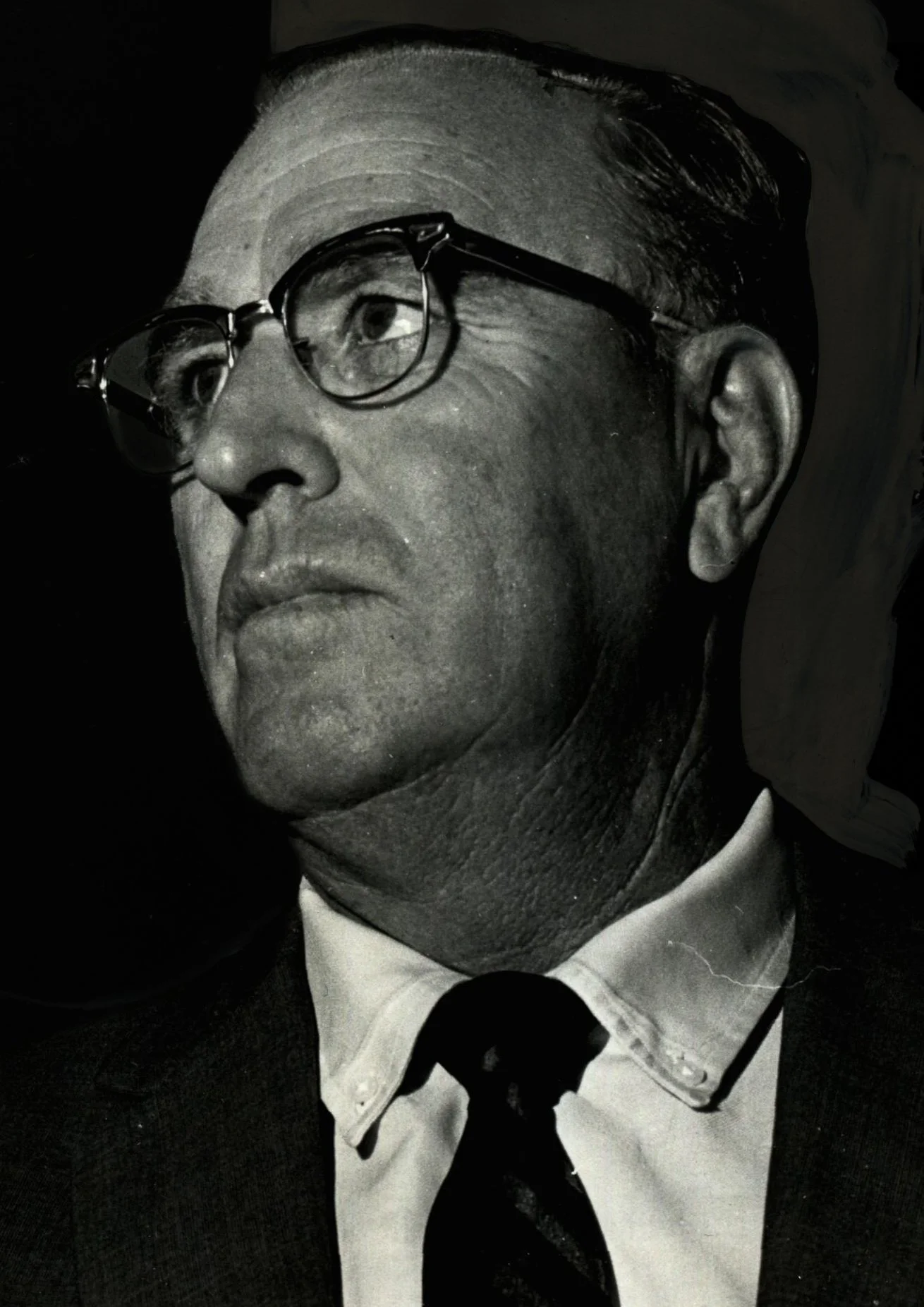
Photograph of Lowell Lawrence "Red" Males used for a story in the October 29, 1961 issue of the Daily Oklahoman newspaper. Photo from the Gateway to Oklahoma History
L.L. "Red" Males was born in 1907 in Doxey, Oklahoma, and grew up on the family farm in Roger Mills County. After graduating from Strong City High School in 1925, he began working at the Strong City bank as a janitor. He worked his way up in the bank as Cashier and eventually President of Security State Bank in Cheyenne, a position he held for nearly fifty years. As both a banker and landowner, Red Males became one of Oklahoma's most influential champions of conservation, shaping not just his county and state, but the entire nation's approach to watershed management.
The Vision Emerges: 1937-1947
Red Males' conservation work began in earnest after the 1937 Oklahoma legislature passed the Soil Conservation District enabling law, opening the way for local conservation organizations to form across the state. In 1938, the Upper Washita Soil Conservation District was established—among the first in Oklahoma. Red Males was elected to the board of supervisors in 1941, just as the district began to ramp-up its work with the Soil Conservation Service.
During the 1930s, Males witnessed firsthand the dual devastation of soil erosion and floods suffered across western Oklahoma. The memory of the catastrophic 1934 Hammon flood—where families lost everything and between 200 and 300 people were left homeless—remained with him. These experiences convinced him and other that upstream flood control was not just possible, but essential to the future of the Washita River valley.
When Congress passed the Flood Control Act of 1944, it included authorization and funding for accelerated land treatment on the Upper Washita River watershed—dramatically expanding the scope of the district's work. A 1947 newspaper article reporting on an award the Upper Washita SCD supervisors received for outstanding leadership gives a sense of the scale of the work undertaken. In one year alone, the Upper Washita Conservation District was responsible for distributing equipment—12 grass drills, 2 seed harvesters, 1 brush mowing machine—and seed—12,500 pounds of native grass, 9,400 pounds of winter legume, and 1,883 pounds of lovegrass—to 219 district cooperators completing conservation measures on their farms. The district's professional capacity had grown so substantially that two SCS work units now operated in Roger Mills County, with additional units positioned throughout the district.
Building the Partnership: 1938-1950
Red Males and other leaders in the Washita Valley understood that addressing the region's erosion and flooding challenges would require coordinated action across the entire watershed. In February 1938, Males was among the conservation leaders who formed the Washita Valley Improvement Committee. That committee evolved into the Washita Valley Improvement Association in 1940, and later into the Washita Valley Council of Soil Conservation Districts—a federation representing all 19 districts in the Washita Basin. These organizations worked together to advocate for federal support and, crucially, to coordinate the acquisition of easements from landowners for watershed projects.
Sandstone Creek: The World's First Integrated Watershed Project
In 1950, SCS officials and local conservation district leaders selected Sandstone Creek—a 65,000-acre tributary in western Roger Mills County—as the first watershed to receive the upstream flood control treatment combining soil conservation measures with small dams. Between 1950 and 1952, 24 dams were constructed as part of comprehensive soil conservation plans across the entire drainage area. The project required coordination across multiple landowners, integrated land treatment with structural measures, and demonstrated that watershed-scale planning could actually work. In 1952, Sandstone Creek became the first completely treated upstream watershed in the nation.
From Local Success to National Model: 1953-1954
Red Males' leadership of the Washita Valley's conservation efforts soon gained national attention. In February 1953, Males and fellow Washita Valley leader Richard Longmire traveled to Washington, D.C., to meet with President Eisenhower, Secretary of Agriculture Ezra Taft Benson, and other cabinet officials. As part of a delegation of leading watershed advocates from across the country, they presented the case for a permanent national small watershed program. Their advocacy helped shape the Eisenhower administration's commitment to the "partnership" approach—federal support for locally-initiated conservation projects administered through soil conservation districts.
That partnership vision was codified in August 1954, when President Eisenhower signed Public Law 566, the Watershed Protection and Flood Prevention Act. P.L. 566 authorized the Soil Conservation Service to work with local conservation districts to undertake upstream watershed projects nationwide. The Washita model—and the principles Males and others had championed—became the foundation for a national program. The legislation transformed the Sandstone Creek demonstration project from a local success story into a template for watershed management across the United States.
Recognition and Continued Leadership: 1957-1990
Red Males' advocacy earned him national recognition. In 1959, he was named the National Watershed Man of the Year. He continued serving as a charter member of the Oklahoma Water Resources Board from 1957 to 1985, and in 1985 received the Water Pioneer Award. Both he and his wife Lorena were inducted into the Western Oklahoma Hall of Fame. In 1984, Governor George Nigh proclaimed July 7 as "Red Males Day" across Oklahoma, and the town of Cheyenne renamed its main street L.L. "Red" Males Avenue in his honor.
Red Males remained active in conservation leadership until his death in 1990, maintaining his involvement with soil conservation districts across Oklahoma and serving as president of Security State Bank for nearly fifty years.
A Legacy Written on the Landscape
The physical legacy of Red Males' decades of advocacy is visible across the landscape: the 24 dams of Sandstone Creek, the 97 structures in Roger Mills County, and the 2,107 flood-control and water-conservation dams built across Oklahoma as part of the Washita River Project and similar watershed programs nationwide.
The Enduring Partnership Model
These structures, built on the principles Males championed—local initiative, federal partnership, and watershed-scale planning—continue to provide flood protection, water supply, irrigation, and recreation benefits to thousands of people. More fundamentally, the soil and water conservation practices applied across Roger Mills County and throughout the Washita Valley transformed a landscape devastated by erosion and floods into productive agricultural and ranching country.
Red Males' greatest legacy is the enduring partnership model he helped establish—one that remains the foundation for conservation work in Oklahoma and across the United States. From a young banker's conviction that upstream dams could prevent catastrophic flooding, he helped create a national program that has touched millions of lives and continues to serve communities nearly seventy years later.
Join the Oklahoma Conservation Historical Society on our website and follow us on social media to discover the stories of conservation leaders who transformed Oklahoma's landscape and protected our communities for generations to come!