
Sandstone Creek — Nation’s First Small Watershed Project
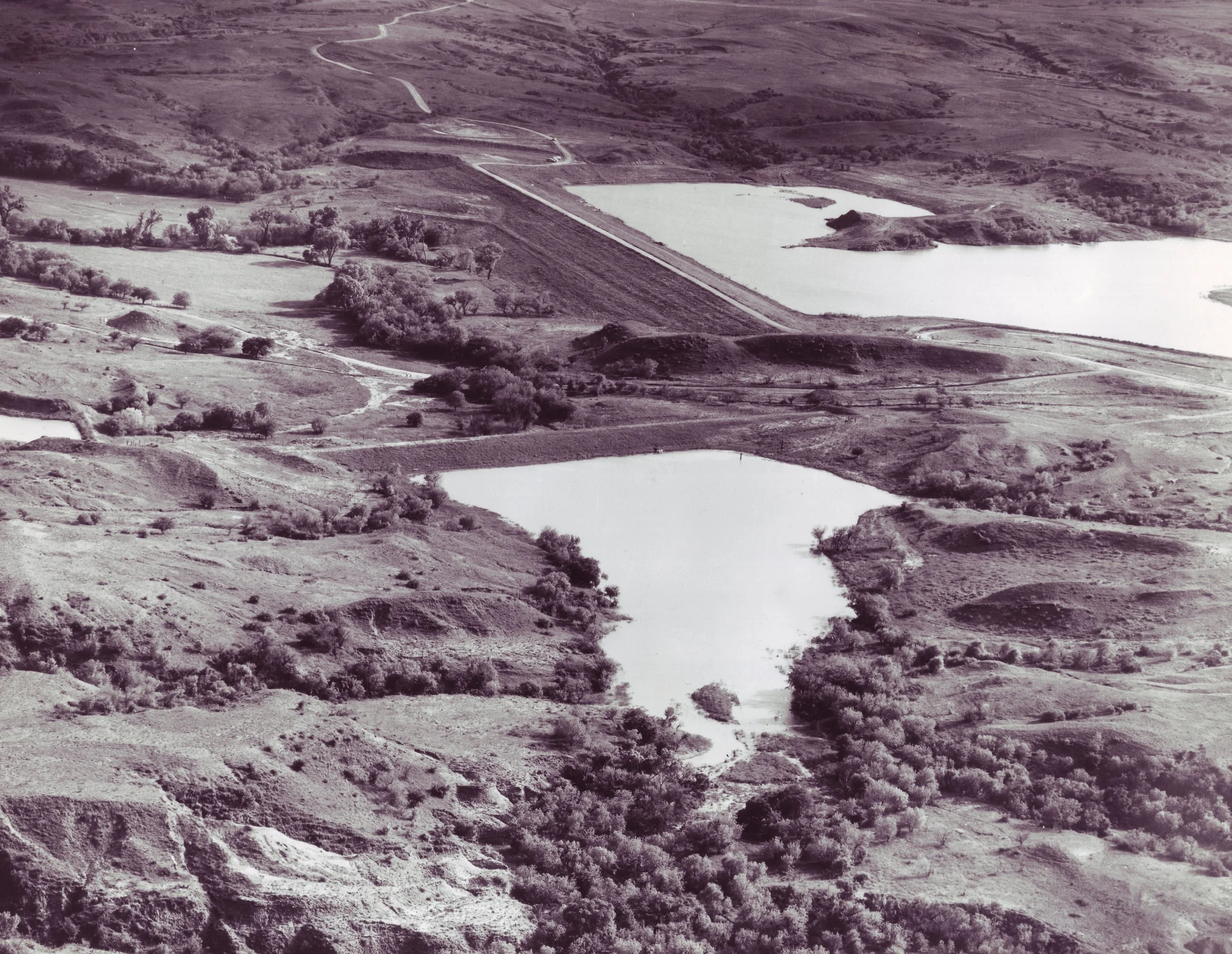
Photograph of an aerial shot of two of Sandstone Creek Washita Watershed floodwater retarding structures and the surrounding area, Roger Mills County, Oklahoma, May 19, 1957. Photograph from the Oklahoma Conservation Historical Collection on the Gateway to Oklahoma History.
A National First in Watershed Conservation
In 1953, Sandstone Creek Watershed in Roger Mills County achieved a historic milestone: it became the nation's FIRST watershed project completed under authority of the Flood Control Act of 1944 (P.L. 534). While Cloud Creek #1 was the first upstream flood control structure, Sandstone Creek was the first entire watershed to have flood control dams built on its tributaries and soil conservation practices applied to the surrounding landscape. With all 24 planned flood water detention dams constructed, Sandstone Creek prove that comprehensive watershed protection was not just possible, but replicable nationwide.
The Washita River: One of 11 Pilot Projects
The story began nine years earlier. When Congress passed the Flood Control Act of 1944, signed by President Franklin D. Roosevelt on December 22, 1944, it authorized 11 upstream watershed control projects in 12 states. The Washita River Basin in Oklahoma was one of these pioneering projects—selected because it had experienced devastating flooding, including the tragic 1934 Hamon flood that killed 17 people.
The Washita River project represented a new philosophy to flood control: instead of building massive dams and levees downstream after catastrophic floods, prevent floods upstream through strategically placed dams and treatment of the land with conservation practices.
Why Sandstone Creek Mattered
Sandstone Creek wasn't just another watershed project—it proved the concept worked at scale. When all 24 planned dams were completed in 1953, Sandstone Creek demonstrated that:
✓ Comprehensive watershed planning was achievable ✓ Multiple flood control structures could be coordinated across a watershed ✓ The benefits extended far beyond flood control: water supply, wildlife habitat, recreation, economic development ✓ Local cooperation and federal support could work together effectively ✓ The model could be replicated nationwide
This success contributed to passage of the Watershed Protection and Flood Prevention Act (P.L. 566), signed just one year later in 1954, which expanded the small watershed program nationwide.
Oklahoma leaders like L.L. "Red" Males, Lloyd Church, and Richard Longmire were key advocates for the Washita River Project, and their tireless advocacy contributed directly to the passage of P.L. 566.
National Impact
The Washita River project and Sandstone Creek's success influenced national policy. Today, 70+ years later, nearly 12,000 watershed dams nationwide protect 47 million people and represent a $15 billion national infrastructure investment.
Sandstone Creek's Legacy
Today, the 24 dams of Sandstone Creek Watershed continue to protect Roger Mills County and the entire Washita River valley from flooding, while helping to control erosion, providing water supply, and supporting wildlife habitat. This historic project remains a testament to Oklahoma's leadership in watershed conservation innovation.
Want to learn more about Oklahoma's conservation history? Join the Oklahoma Conservation Historical Society on our website and follow us on social media for ongoing stories, photos, and resources!
Have you visited Sandstone Creek Watershed or been protected by a watershed project in your community? Share your story!