
Oral History Interview with Nolen J. Fuqua
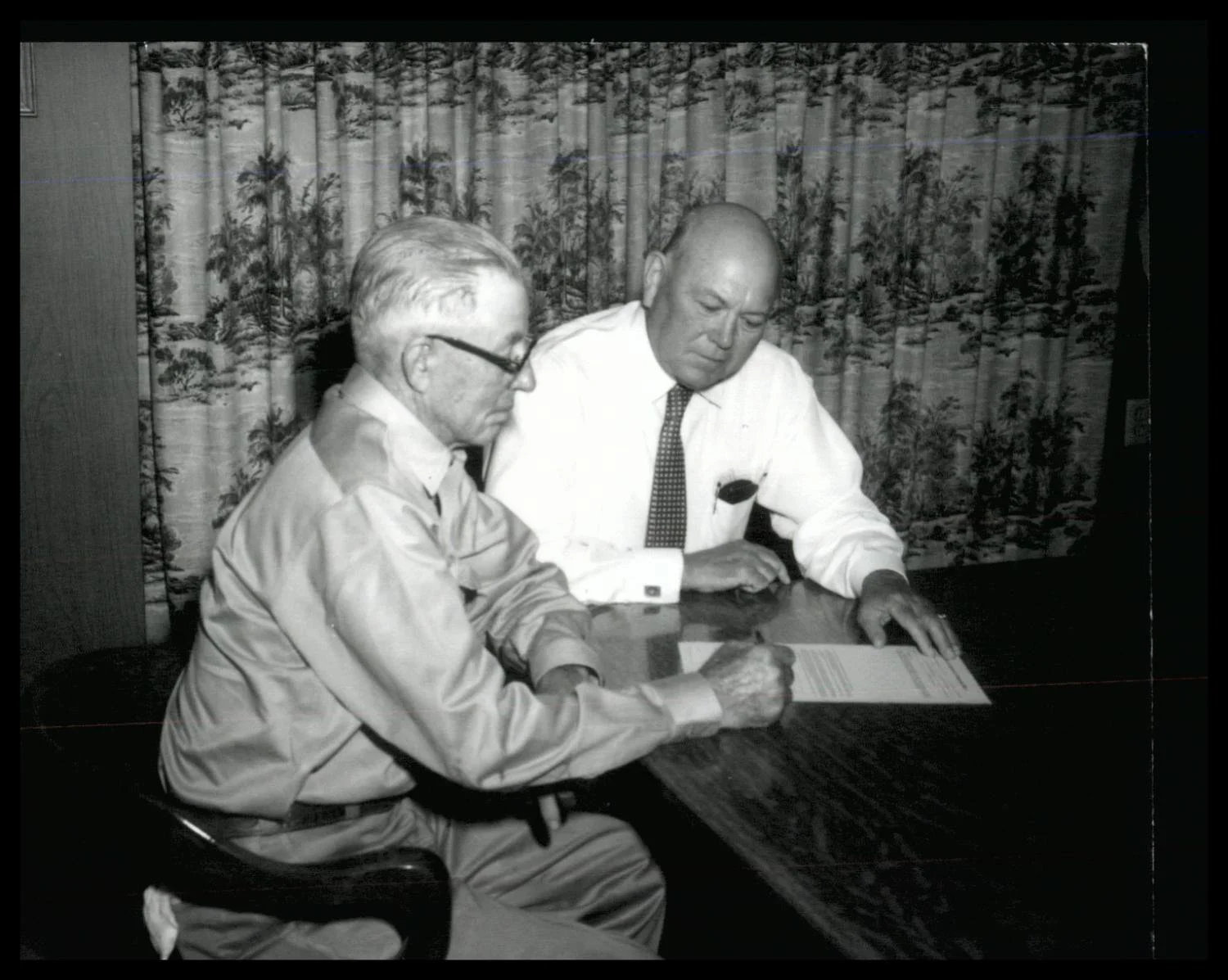
Nolen J. Fuqua (right) with landowner John Morgan (left) signing easement for Wildhorse Creek small watershed project, c. 1950s. Image from the Oklahoma Conservation Historical Society on the Gateway to Oklahoma History.
Oral History interview conducted on September 16, 1983 in Duncan, Oklahoma by Douglas Helms for the Soil Conservation Service
HELMS: Before we get into the conservation area and the district movement, could you just tell me where you were born, something about where you grew up, leading up to the point when the soil conservation work starts here in Stephens County.
FUQUA: Right. I was born here in Duncan, Indian Territory, on March 25th, 1894, and have been here since that time. Out a few years, at different times, but this has been my permanent home. I grew up as a common, ordinary citizen, learning all I could as I came up. And after graduating from school and coming home, getting into the investments we had, I, one day by accident, I guess, led into my involvement in an organization called soil and water conservation programs--due to the fact that they had chosen a creek here as one of the examples of a watershed program. I had two pieces of property included in that program. They built my terraces and improved my pastures, killed the prairie dogs, built tanks, cut out trees, put up nice fences and made it look like somebody lived here. I appreciated it so much that I spread the news around the co1IUI1unity that it was a good program, that we should fall in line and get after that type of a program. So the outcome of talking too much was that the manager of the CCC camp, who was doing the work here, came out one day on the golf course and picked me off the number 9 green and asked me to become a supervisor ·for the district. They were organizing a district. Well, I was flabergasted because I didn't know what he meant by district, didn't know what he meant by soil conservation, and protested as much as possible but he inveigled me into it. Well, the outcome was we •.•.
HELMS: This is about what, 1938, I would assume?
FUQUA: Yes. The outcome was we were advised that those who had volunteered to be supervisors would go to Stillwater, the Oklahoma A&M College, and get briefed on what our obligations and duties would be as a supervisor. Which we did, one hot July. No air conditioning in those days. We were flogged with a Washington educators, till they wore us out. And finally we got all we thought we needed. One fellow said, "If you give me a desk and a tractor and a blond secretary, I'll go back home and start this district without anymore information!" So, we got to that point, with the heat we decided that maybe it would be the best thing we could do would be to get together and organize and get out of this sweat field. So, one day at noon, when the Washington boys were at lunch, we fellows got together and decided we'd organize a state association. And the outcome was we had a night meeting. Several of us got in there and wrote up our constitution and by-laws. Elected officers. And they threw me in as president. And I had to stay in that job for eight or nine years, before I could get loose from that.
HELMS: Let me interrupt you just a minute.· When you say the head of the CCC camp, whoever that may have been, approached you about being a district supervisor, you hadn't been involved in the passage of the state law or getting the district organized.
FUQUA: Didn't have any before that. But after we organized our association, the first set-up that we had in the state was a state committee. The Soil Conservation Committee, composed of a president, Dr. Bennett, of Oklahoma A&M, and his son-in-law, and another gentleman who was in charge of the Future Farmers organization, and the head of our extension department. That was a committee. Well, that rocked along for a while, and we had a state law passed and had some money to dispurse. They were supposed to give us guidance and direction as to how to operate. Well, this all fell into a political pool. Bob Kerr was the governor, and Dr. Bennett and Bob were using this money for political purposes. Just getting themselves all lined up to do what they wanted to do with our money.
HELMS: How did this come to your attention?
FUQUA: We weren't getting anything done. And we couldn't get them to come out and take an interest in it.
They weren't interested to speak of. Once in a while they'd come out and check on us. So we decided the best thing for us to do was to do some more organizing. But we went to the state legislature and told them that we wanted a reorganization and wanted to get rid of that state committee, and let us head up a committee that would work with us, out of our own group, Those fellows didn't know what they were doing. Well, the result got so hot that we finally ended up with a joint session of the state legislature of the house and senate one night. Bob Kerr was master of ceremonies. Dr. Bennett and his committee were supposed to be there. We were going to have a hearing right before the whole group, and get this thing all ironed out. Well, when we got up to the meeting, why, we got into this questioning and the reason for being there. They said, "Well, where's the committee? Is Dr. Bennett present?" They had only one fellow there. This fellow was in charge of the Future Farmers. He was appointed by the legislature. And he said, "No, Dr. Bennett is out of town tonight. Well, where's the rest of the committee?" He said, "Well, I'm supposed to speak for them.11 Well, that didn't sound good at all.
We were there, one hundred percent. Well, we got down to the nitty-gritty and asked some questions, and this boy said, "Well, I couldn't answer that Senator, you'll just have to ask Dr. Bennett about that." So, the outcome was that the legislature, representatives who appointed this boy as head of the FFA said listen--calling him by his name--I've forgotten it. You either answer that question or you are going to find out later that you are not in that job of yours.” They said, “Who got your job for you.” He said, “You did sir.” They said, "You won’t have it if you don't answer those questions." So, it got that hot. And, so we finally came down to the finish of it, and decided that we could have a state board. We wanted representatives from each congressional district. We wanted to select our men. Well, that hit a rough spot, but Kerr said, "I think I1 11 have a little bit to say about those appointments, but let me pass on them." So he passed on them and he got one or two dogs in there who weren't very good. We finally shelved them. The extension department seemed to think that we were taking their place.
We were infringing on their programs. And we were not. So, after this session, our appropriations were set up. Dr. Bennett had not broke up his committee. But we had a state association meeting right after that, and all went home pretty well fired up. Dr. Bennett tried to solve the situation. He said, "I want to call all you fellows back and have a meeting with you and talk to you about this budget, what we would like to do." Well, the rest of the fellows said tell him to take a jump, we're not interested in his business. I said, "No, let's all go up there, everybody. This is the very time we can really lay the wood to him." And so we went up, nearly a hundred percent, at his meeting.
HELMS: This is all about 1940, is it?
FUQUA: Well, yes, it was the early part, it was just getting organized. They'd been going a year or two with that program. We were tired of it. So we went up to the meeting, and Dr. Bennett opened the meeting, we were all sitting there listening to what he had to say. I was on the front row. And he said, "Will you come up and sit with me Mr. Fuqua?" I said, "No. This is your meeting, go ahead and have it.”
Well, he was not getting anywhere with his program, so at noontime, he said, "Will you go to lunch with me?" I said, "Yes sir." So, Dick Longmire and I went to lunch with him, and we straightened everything out with him what we expected to do and he should just get ready for it. So, from then on, why, we had our state committee appointed. And then, other things were breaking out over the country. Some of the people couldn't get started on their state associations. They were kind of dilapidated. Some of them were going and others not. All this confusion was going on. So Dr. Hugh Bennett thought that the whole organization should have a resetting and get organized so that we could operate. So he called a volunteer meeting between the Soil Conservation Service (SCS) and the districts, plus the AAA and their people, in Auburn, Alabama. We drove down there in a little Chevrolet, took one of the A&M boys with us as a strong force, forgotten his name, took the state SCS director, and we had the regional man with us, Louis Merrill. Also, presidents of state associations were gathered down there. All of them knew what they were down there for. Well, we had our meeting and it turned into a confused argument and finally it was, decided to set up panels. "Districts, you get your panel up, AAA get your panel up and we will set you up here and we will flush this thing out." Well, it happened that the panel with the district representatives had MacArthur from Carolina, I was another, and I've forgotten the other. There were three of us. They got to throwing questions at us. Asked us what good we were and what use we were, and so on. And how we could ever get together and do the job. And one fellow, said to MacArthur, "You _don't look like a farmer." He's dressed up there, vest, got a bow tie on, cleaned up." Mac said, "What makes you think that?" He said, "Well, you just don't look like a farmer to me." Mac, he reached into his pockets and said, "Read that." It was a five hundred dollar check for being the outstanding cotton grower in Carolina. He said, "Now what do you say?" And they went on with the questions.
Anyway, we had a rip-roaring time down there. We came back after it was disbanded, and Doc Bennett says, "Get organized, get organized." Well, we tried to organize a national group right there, but it flew apart somewhere.
HELMS: So you didn't resolve your problems with AAA but this was part of the organizing process?
FUQUA: That's right, we didn't get anywhere with Triple A. And they didn't get anywhere with us so we went home still fighting. Came back. When we rode back home, quite a group of us came back this way. Texas and Oklahoma were well organized and had a pretty good group. We had Merrill and our state men with us. Our state man of Oklahoma pulled out. He didn't want to get in that. He was afraid he would get fired. But we stopped in Shreveport and organized, what we called a Soil and Water Conservation Affiliated Association. So we could take in these other boy, make them an affiliate.
They elected a president and I was vice president. And we had our set-up. About that time, well, the war broke out. Took our president and the whole thing flew apart. So then, we, well, there was a group called into Washington, I didn't happen to be in that group, but they were called into Washington to kind of put their marbles together and reorganize. Set up an organization, a national organization.
HELMS: This is during the war years, or after?
FUQUA: No, during. So the outcome of that group was that we were to meet in Chicago and proceed to organize a national organization of soil conservation districts. And, most of those attending were presidents of state associations. There were quite a few state associations then. Well, we met in Chicago at the Morrison Tower Hotel. And we had elected MacArthur of Carolina as the president, and on down the line. I think Kent Levitt was vice president, at that time, of New York, And for a very short time after that organization, we had our directors and all set up, perfect for an organization. Well, MacArthur was killed in an automobile accident. So we immediately put Kent Levitt in as president. I don't remember whether we had a special election or what. But anyway, he was vice president, I think. He stepped in. Well, from that time on, Kent spent most of his time having state organizations set up all over the nation. He did a lot of traveling.
HELMS: That was to get good, strong state organizations?
FUQUA: Right. Well, Kent served his time out.
HELMS: Anything you want to say about that period is fine with me. I'm not rushing ahead.
FUQUA: Well, after Kent served his duty, we elected Waters Davis from Texas, as our president. I might say, our first national meeting after the organization was held in Des Moines, Iowa. And from there we moved to Denver. And, Waters Davis was what you would call a high-roller. He really stepped into it with a lot of vim and vigor and was what you would term a hard-boiled organizer. He believed in fighting them. And he was fighting most of the time. Together with the rest of us.
HELMS: You were still having a lot of opposition?
FUQUA: Oh, Lord, yes, it was burning us down. Everywhere we'd rise up, somebody would slap us down, you know. We had an awful time making them understand what we were. We were not a government organization, from Washington; we were local people, trying to work with the local people. And supervised by SCS engineers out of Washington. But we could, have never yet, made the people believe what we actually were. But during those periods of time, we were busy going into Washington, trying to get a national laws organized to where we could operate. And.…
HELMS: You mean not your by-laws but national legislation...?
FUQUA: Yes. We had our by-laws and all set up in pretty good shape.
HELMS: What did you want to change about the legislation?
FUQUA: The laws were so loose they were not operatable, you might say. They had to be modified and amended and fixed up to where they would really fit in with our program, that we had set up. So, during all that period of time, we spent most of our battles trying to get the agriculture department to understand and coordinate their program with us. They still believed like the local people did here. When they began the state association, that we were infringing on the Extension Service and their program. But we finally convinced them, after many years, that we were a working concern, and that they were an educational concern. But we, let's see, Secretary Benson, I guess, was in there when we were really doing our stuff. But, in our coming-up days when all the fighting was going on, we even had the Farm Bureau fighting us. And one or two of the other organizations. But the one group, the Farmers' Union, and Grange, were staying with us all the way. The Grange was right by our side. But we were having an awful lot of trouble with the Farm Bureau. I've never seen the fellows so upset with each other as was Waters Davis and the President of the Farm Bureau. O'Neal and the next one. I've forgotten his name, but anyway, they were terrible. And when we had our organization trying to get some of the laws changes in Washington, especially the watershed program.
The first five to six did not operate. We had to change it all up, relocate some of the operations that they had in it. And to do that, we had to get the Farm Bureau, Wildlife, and the Farmers' Union and all their group together to agree on something that would be feasible. And Waters Davis said, "You can't do that." I said, Waters, "We can
try." And, so sure enough, when it came to a showdown, I had them all together up there in the Dupont Plaza Hotel, and we set down there for a half a day and mulled that whole thing over, put in what we wanted to, took out what we needed to, and come out with a workable bill. And it went through just like that. So, ….
HELMS: This was to amend the one that had already passed?
FUQUA: Yes, put it in a workable position, so we could operate. I don't know how many different things were wrong with it. I couldn't recall all of them now. But we had it all well-lined out and SCS was in there working with us, to help us keep the thing straight. So it went on in pretty good shape, but all along, from that period on even, why we still had trouble with Benson and the Farm Bureau. They were after us every way we could go.
HELMS: You remember much about this reorganization plan and right after Benson became Secretary of Agriculture.
FUQUA: I was elected president in San Diego. We came back for a regional meeting in Dallas, right after that. And while this meeting was in session, this Hoover Commission was set up to reorganize the agriculture department. And in that program was a plan to abolish the districts. Well, we were busy with our regional meeting there and we got this wire coming in about what the Hoover Commission was doing. Waters Davis goes out and buys me a ticket to Washington. And they said, "You get on up there and get in that commission and stop this thing." I said, "I an't leave like this." I said, "My wife and her friend down here are out shopping. I can't leave them out there. I drove down here." "Oh," he said, "we 111 take care of that. Get on the plane. Your tickets here and go on." Well, I got right on the plane and left without notice and went to Washington to check in on it. There wasn't any way that I could get into that commission. But I happened to have a good aide, because aides are better to get into anything than the man himself. An aide to Humphrey was on the committee. He's a good friend of ours. And I asked Waters if he could get ahold of an aid of Senator Humphrey, a member of the commission. Let's talk this thing over, and let's see what they were about to do to us. And get this thing stopped. He did that and that was that. And Humphrey went right in there and he smoothed it all out. He did not have any trouble. But still, ….
HELMS: Humphrey from Minnesota?
FUQUA: Yes. We were still back with the Secretary of Agriculture, he had not cooled off any, because he was still after us. He had a hatchett man in there., This old boy from California, I've forgotten his name.
HELMS: Yes, I know who you are referring to.
FUQUA: But we were in Providence, Rhode Island in a Regional Meeting. We got a wire that this guy was cutting us off. Get to Washington now.
HELMS: What were they going to do?
FUQUA: Abolish districts. Yes, didn't have any use for them. Well, we headed for Washington that afternoon and we met the gentlemen down there, and boy it got rough. He did not know what he was
doing. He had no program. He said they were going to set up a new program. When we asked him what it was, he didn't know. It's a new one. When we come back out of there, why, we really had a fire burning, and everything blocked. But it wasn't long before he was gone. He was back working for The Bank of America again, where he belonged in the first place. Anyway, we had such run-ins as that. We were trying to get to talk to the Secretary of Agriculture. But that was just out of the world, he wouldn't look at us. Thought we were a bunch of skunks I guess. But anyway, we worked through Don Williams. He was head of our SCS at that time, but we couldn't do any good there. Finally, I made friends with a boy down there named Bob McMillan.
He was an understudy of Benson. And we got to kidding with each other quite a bit and we became pretty good friends, found out that we were decent people. So, things got so bad for, I said "Bob, could you get me in to talk to the Secretary." He said, "Yeah, I think so." I said, "I'd sure appreciate that if you could do that." Well, he got me in, and I went in and sat down and introduced myself to him and told him a little bit about my background, that I'd like to talk to him a little bit about our soil and water conservation districts. Well, he dragged along a little bit and I said, "I've met you before. I met you at a national Boy Scouts meeting one day not too long ago. He said, “Are you a boy scout?" I said, I've had about 50 years of it. I was in that before I got into this." He said, "How in the world did you ever get into this?" Well, I told him the story.
I said, "Mr. Secretary, I've always been trying to do the right thing about what my free work would be. I have two things I especially wanted to do and accomplish if I could. One was to build character in our young men through the Boy Scouts (and I hit a soft spot in him). The other one was to preserve our soil and water. With those two things our nation can't fail." Well, he choked up and said, "I guess you're right." "So that's what the districts are trying to do. And we need you on our side." Well, that old boy softened up like nobody's business. We got to talking with each other. The outcome was, right or wrong, we had a national convention in New Orleans. And I asked him, "Mr. Secretary, I said, how would you like to be our principal speaker at our convention in New Orleans this year?" He said, "You want to get me shot." I said, "No. I sure don't. I just want you to make some good friends. We've got about four thousand people down there that are just fine people. You'd really appreciate them as your friends. You can do that if you come down there and make them a talk." Well, he mulled around awhile and finally he agreed that he would come down and make it. I said, "Al1 you have to do is say the right thing. You 111 be all right. Nobody will shoot you." So he came down to make his talk and Waters Davis was just shaking in· his boots. He thought, I wouldn't have him down here for nothing. I said to Waters, "He's going to sit by your side. You just better get ready for it’II And, so he came down there and he made a canned speech, you know, somebody wrote it for him. So, when he made his speech he did not get a return, not a cheer. Everything just quiet. No reception. And I felt sorry for him. He hadn't said the right thing. And I told him, I said, "Mr. Secretary, we have a little girl over here that's on next for a speech. She's a champion speechmaker for soil and water conservation in the nation. And she happens to be from my home county. When she makes here talk, your eyes will probably get a little damp and maybe drip a little." So she made her talk, and when she got through, he kind of nudged me a little bit and said, ''would you mind if I get up and say a word or two?" I said, "Help yourself." He got up, and made a speech right off the cuff there, and when he finished, they gave him a standing ovation. And I said, "Now, you see there what you've done." He said, "I see what you mean." Well, we never had anymore trouble with Secretary Benson after that.
HELMS: What was the little girl's talk about?
FUQUA: The meaning of the program that we were putting on. What the benefits should be for the nation in keeping the soil and water conservation, just a good, good talk for our program. Then later on•••. We got a little ahead on that convention there. I had another fellow that was really giving us a lot of trouble, he was the editor of the Farm Journal, Wheeler MacMillan.
HELMS: And this is what time?
FUQUA: That was before we had this spree with Benson.
FUQUA: It's a good story too. I had run into him a number of times at different conventions, the Chemurgic Council was especially one that he got pretty warm about. After the meeting was over, he said, "Have you got time to come up to my room for a while tonight? I said, "Yes." Well, I went up and talked to him and he was wondering about what all this ruckus was about and said, "The first thing I want to ask you is how come you are such a good friend of my son?" I said, "Well, we just met down in Washington. We just got to talking to each other and become friends, that's all." He said, "Well, he said some things about you and your program . I don't know just how to explain it." I said, "Well, I'll tell you. You just don't know exactly our business I don't think really." After about 1-1/2 hour visit Wheeler understood. Well, later on we wer on our way to, to Boston to set up a convention. That was my first convention after I was president. We stopped off in Philadelphia and had a conference with Wheeler at his office. And he sat Waters down over there and me over here and another boy back here, and brought in all of his editors and picture boys and he sat in a big desk back in the corner there and first question he asked, he said, "By, what reason do you fellows have to exist in this organization?" Well, that sprung a leak in Waters and he let him have it. We got into a pretty hot argument about the whole situation. And finally broke up, and he took us over to the club for lunch and had a very nice lunch and said good bye and so forth, and hadn't come to any conclusion on how he thought about us. We couldn't prove much then. So I put him in the same kind of proposition that I did Secretary Benson. I said, "Wheeler, you're a good speaker. We would like to have you speak at our Boston convention for us if you will." He didn It want to do anything like that. I said, "Just try to do it. Just improve yourself a little bit, I think you'll like it." So he came up and made us a speech. Did not have anymore trouble with Wheeler. He was on our side from then on. So those were some of the things that we ran into trying to get ourself on the map, where we could be recognized.
HELMS: You sort of present this as, if I'm right, that some of the people, your opposition, were sort of opposed because they were told they should be opposed and never really investigated the purpose of the districts and so does that….
FUQUA: That's more or less the real story on the thing. After they found out about the whole situation, it turned them around. But there were some really rough times in it. After we grew up pretty well, we had to become a little more stable. We were just a floating organization, you might say. We had no headquarters, we were just fl'oating through and Tom, Dick and Harry here and there. We decided that after we put Waters in that we would open up a home office down at Laague City. Well, that worked all right as long as Waters was president. And then we decided that League City, at least part of us did, that that would be a nice place for a nice headquarters. Well, you know, the north and the south, and the east and the west, all got kinked up and had a hard time deciding about a thing of that kind. Waters had just presented us with a hundred thousand dollar office building. He would do. that if we would locate down there. So, I was president at that time and the only way I could get the thing settled was to have the, the northeast said we don't want it up there. And the middle here said we'd like to have it in Des Moines. The west was some other way. I said, "Tell you what I am going to do to settle this thing. We are not going to settle it arguing it together. I am going to set up a committee to decide on this, if you will agree to it. Try to get a committee that would be fair all the way. And let them make up their mind about what would be the best to do for this thing." So I set up a committee and had a man from Louisiana named Marion Monk, a good friend of mine. He was on the committee. I had another boy in Washington state. Another boy in New Hampshire. Well, they came up with a recommendation and we had surveys and everything else made. And one survey that ran through settled on Omaha. Well, we had a meeting in Omaha right after that happened and the vice president, Bill Richards, who lived in Nebraska.
FUQUA: So in this meeting we had to hire some new executive director. I had applications from several.
HELMS: Had you had an executive director?
FUQUA: Yes, he had, he was going out. His health had failed him and we had to hire a new one. Well, the outcome of that was I had these applications in and had some very fine fellows who were working for us. And we were not very well financed. So, these boys were drawing pretty good salaries who were applying for the job. Well, we had a secretary selected. He would serve only if he could stay in Washington. Gordon Zimmerman, was the best one in the group who had applied, pretty high-powered salary and an office in Washington. Well, my treasurer he buckled up and said hey, ''We can't stand that kind of expense. We opened up the Washington office, and paying that kind of a salary. I said, "Waters, if we can't stand it, we can do away with it. If we don't pay for his expenses and that little office we are going to have up there we've made a mistake. But he'll pay for it I think." So we put him in. Waters printed up what his desk and what his typewriter and all these things were going to cost. And anyway, we opened up our Washington Office. Inhe meantime, while we were doing that, setting up the Washington Office, I'd had a Bob McClellan, who was working as an assistant under me to take over some of my obligations I couldn't call everybody, so was an assistant here, working here in my office. We decided that we'd have two extra men work the field. We were going to put Bob McClellan and Clair Guest, our other boy in Louisville. And open an office in Washington, Well, that was out of this world. But it went over. We decided that would be it. But it was so rough that Bill Richards had already given the word that Omaha, had it on TV and radio, that this was going to be the headquarters of the national association, before we ever voted for it. We decided on this other tryout. And when that happened Bill got up and said, Hell, I'm resigning and took off without his luggage. I sent Sargent at Arms out there and told him to bring Bill back. He wasn't about to get away like that. Brought him back and sat him down and we finished our meeting. But it got pretty bumpy. But that was the beginning form of our organization. Now, we have our zones in different places. Put it on a working basis, like an organization should be run.
HELMS: Yeah. And you think putting it in Washington was the right decision?
FUQUA: Yes. It's proved to be our life-saver. Forjgetting what we want in Washington. But we had a lot of interesting things that happened in going along with the testimonies to the different committees in Washington. One particular one I remember was that we had a hearing before the Senate Agriculture Committee. Dick Russell was chairman.
HELMS: This is about what time?
FUQUA: It was oh, probably 1954 or 1955, something like that. 1955, I guess it was. And so we were having a board of directors meeting at the ·same time as testimony was going on, so I asked him, the night before, "Senator, would you mind if in our appearance in the morning, I brought the board of directors in and have them meet you and introduce themselves." "No, I'd be glad to have them." So I brought the whole board down, listened to our testimony before the Committee, and introduced them, I told them stand up and tell them your name and where you're from and what you do. Well, they all stood up and told a story, and Dick Russell, he just kind of wilted down. He said, I never would have believed anything like this could have happened unless there was some type of millenium. People coming in here, paying their own way, and testifying before our committee and telling us what we'd like to have done out in the country." I thought it was a fine expression. And another time, we had another meeting before the same committee, Senator Bob Kerr was on that too. And our friend down there from Louisianna, Ellender, an old bachelor, an old crackerjack. He stayed with us a hundred percent all the way. He was a dandy. He had some of Waters Davis. He'd tell them what it was. Anyway, we'd been before that committee one time with testimony. We were last on the list. We were heavy on our watershed program. Getting it sold. Along about five o'clock, why we came up for testimony, and we were going to have to finish up pretty soon. It was getting late. So we gave our testimony, and we stretched it out a little bit. I said, "One other thing, I'd like for you to listen to and look at. We have a gentlemen here that will show you some slides on one of our water programs out in Oklahoma." He had a bunch of slides. He showed about development of this sand stone watershed.
HELMS: Was this the Sandstone?
FUQUA: Sandstone. He gave this slide rendition and we stayed there till after six o'clock, listening to that. They couldn't leave it. Red Males was the one who gave the program. He traveled over the country and showed those slides a number of places. Educated them on watershed programs. But when we finished up, I asked the aid to Senator Dick Russell, "How would you like to go out and have a good Oklahoma steak tonight. You're hungry." And nothing tickled me more. We took him out for a good steak feed, and we told him a few of the things that we wanted to be sure and put in that bill. And, rattled off quite a bit of it, and he said, "Why don It you fellows come down there in the morning. We'll write this thing up. You can help me write it up." Marion Monk and I went down there and told him what we wanted to put in that. They put it in the bill and that's the way it was.We did a lot of our good work with these aides. They helped us out in a lot of places.
FUQUA: Yes. I had an awful lot of trouble with Senator Bob Kerr. He was a heavy Army man. The Army Corps of Engineers gave us an awful lot of trouble. They didn't want these little dams messing up their big lakes. But we were strong for putting these little dams in before they built the big lake. We are still doing that. But we couldn't get through Bob Kerr for anything hardly. I've forgotten his aide's name, but he was a good friend of ours and he realized it was important. And the last time I went down to visit Bob, I said," Bob, you won't agree with us for anything we want. I'm wasting my time to come and talk to you. This is the last time I am going to talk to you as far as this group is concerned on this deal." And left. Bob Kerr and I were in school together. He used to come over to my room and we had these old iron beds and he sat down on that bed and break them down, playing poker or something. But we finally come together before too long and we were getting along fine. And he's turned out to be a good supporter for us. But .…
HELMS: Why didn't he, why don't you think he favored that, he wanted to....
FUQUA: He played for the Army boys all the way. Of course, he had a big program here. He put in this Arkansas program. He and the Arkansas senator built this Arkansas navigation program, built these big lakes here in Oklahoma; And that's what he wanted to see done, one hundred precent all the big lakes. Never broke him down.
HELMS: Well, this is sort of off our chronology of events, but could you tell me your part in the Washita...?
FUQUA: Oh, the Washita River? Well, I was in it from the beginning. We had a Washita Watershed organization and we were, well, it was flooding all the way down, Chickasha, Pauls Valley and all these towns flooding. And just little Sandstone was the first one we completed on that. And so....
HELMS: How did you get sold on the idea that the small dams? Did you have anything to do with that, the 1944 legislation?
FUQUA: Yes, that's what I was telling you about, putting these old guys together so we could get this thing working. P.L. 556, that's a watershed, that's a law. That came out after we had these, I think we had eleven designated locations in the nation to begin with. Washita was one of them that we didn't have to use 556 on. So that was where Washita got ahead of these 566 groups altogether.. But we got a head start on the Washita, I guess. We were the first in the nation to come around with a real watershed program. And I might say one other thing….
HELMS: Could you go into that a little bit?
FUQUA: Yeah. We organized our districts so well that to get all these easements up and down the river there, it was quite a program. And we had our state law amended where it would give us the priviledge of eminent domain. If they didn't want to give the land, we could condemn it and go ahead and put it in. And we had stiff regulations on building these dams. Before we could start with a dam) )le had to have eighty percent of the easements and that was pretty strict. That was holding out a lot of dams but we finally worked it out to where it was fine. We had different streams like a Wild Horse Watershed here in our county. It was an organization supplementing the Washita Watershed organization. Each one of these tributaries had an organization of their own. They did the ground work, you might say. There was a whole Washita Watershed group. You get these. little organizations on each stream. You get a head man on each one of those streams and he'd get the job done. And that's what we did here for example, on Washita, on Wild Horse Creek. I got the president of Security National Bank to come and help me get those easements. We got all the easements on this Wild Horse Watershed. There are forty-five lakes on it. We had a lot of bumpy deals, because we had to buy a lot of land, had to get it appraised and pay the money for it. But, we worked night and day on that, through storms and water and everything else. But that's the way the watershed on the Washita worked out for us, as far as these tributaries were concerned. We got a lot of percentage of it up now. I don't know how many more we lack. But we have it under control. It's not flooding any of the cities. And most of these tributaries were set up under pretty good control too. We had some backfire on wildlife people. When we go around and make a channel, clear the channel for the water to go through, like it should, they don't want to cut any trees down, none of these bushes, destroying the rabbit and squirrels, skunks and other things, don't get them bothered. So we have a little trouble in getting channel work done. But Wild Horse now, is a nice, gentle, clearwater flow, springs are flowing down and the water continuously runs all the time now. No more floods. And we've had floods out there that did millions of dollars worth of damage. It went through here one time, the big flood, and the oil fields were in full development, it washed right away, floated tanks out, and broke platforms. Washed bridges out, it was a ....
HELMS: The Washita, the head of the flood control, was it more of an effect on the little towns and the farm land...?
FUQUA: Oh yes. I had a list here that I was going to use on raising a little money myself here the other day. I don't know where it is now. But it lists how much land we put back into cultivation, good fertile bottom land, the amount of crops we are raising now, and the taxes they were paying that they weren't paying anything on, waste land and running water, ruining land, flooding all the time. And another thing that we did here which is outstanding, is a leader for the nation, to tell you the truth about it. We were the first district to have a upstream flood control unit that would furnish municipal water on top of flood control.
HELMS: Which one was that?
FUQUA: It was Lake Humphries up here on Wild Horse. Talk about which is first, the chicken or· the egg, I had it. When I went to Washington I asked the Soil Conservation Service to cooperate with us on the deal where we could increase the height of the dam and make enough water for the city's use. They didn't know what I was talking about. This is flood control. I said, "Yes, I know that but let's get some city control out of that. Let's get some water for the city. We're out of water. If you go 50/50 with us, or some kind of, give us a chance to build a lake down there that we can get city water." Well, I took it up with them, and they said they couldn't sign any contract like that, unless you get the city to vote it. Well, I came back to the city, and told the city what we could get done if they would vote this bond in. And they were fuddled. They didn't know for sure. I finally got them to vote the bonds or whatever was necessary. We were supposed to do ours in kind. The Soil Conservation Service was to do the paying. We do ours in kind. We furnish equipment and labor. We did most of it that way. So we went in with them on a 50/50 basis and we made us a big lake out there. And that picture was handing up there in the Soil Conservation Service offices for years till Brown, I don't guess you remember….
HELMS: Carl Brown, I never….
FUQUA: Well Carl was the block behind our watershed program at that time.
FUQUA: Later, Hollis Williams went in there. And he had a picture there that was about four by six picture of this, Humphries Watershed Lake. Beautiful thing color. And I wanted that back. And Hollis said you can have it, but I never did get it. But that set an example and there are thousands of lakes now over the nation that are using those lakes for municipal water.
HELMS: Who, then, did you get to support you on the municipal water supply idea?
FUQUA: How do you mean who?
HELMS: SCS. You mentioned you had a hard time convincing them.
FUQUA: Oh, the Soil Conservation Service in Washington?
HELMS: Yeah.
FUQUA: Fats Dykes was the one I was talking to mostly. And he'd make his notes about these different things that I told him. Last time when I went up there to close a deal with him, he said, 111 don't remember anything about that. I can't remember saying anything like that to you." I said, "Get your files out. You initialed it all. You can read them in your own files. So he got them out and he said I did say that." “All right." I said, "we are ready to go in our town. We just want your okay." Well, we got it fixed up and from that day on we have been doing it all over the nation. We have got two lakes out there now, Lake Humphries, and Lake Fuqua. We built two big lakes. Giving us enough water to supply a city of forty-thousand people.
HELMS: And boating and all the rest of it.
FUQUA: Yes, fishing, boating, wildlife, recreation. And what have you. We have nationwide advertising on it too. I happened to be a good friend of the Catepillar boys, and told them about our story that we were running out of water, didn't have anything but some wells down here and they'd gone salty on account of the oil fields salting up our water. And we had to have water. And we had a little old lake down here built by the CCC camp, called Duncan Lake and it was drying up. And they took pictures of that and we wrote up a big story and we got the middle pages of the Saturday Evening Post, the middle pages of Reader's Digest, and the middle page of Time. Advertisement, all over the nation for it, what we were doing.
HELMS: You were still president when the Great Plains Conservation Committee came in, right? Would you tell us about some background?
FUQUA: Well, when they first called several meetings of the Soil Conservation Service, plus interested agencies, and more especially district groups, and we had one session here in Oklahoma and then later on we had a wider spread of representation in Amarillo. And then again, we had another session with the council in Wyoming. The government group.
HELMS: Oh, the Great Plains Agricultural Council?
FUQUA: Yes, I believe that was it. Something like that, some organization along that line, including all the interested agencies. Then the final meeting we had in Denver. That's when they called all the presidents of the state associations in the Great Plains together in Denver, and no government representation whatever except two gentlemen. Don Williams, and Ervin Peterson. We had them there to answer questions that we were not qualified on, you know. And out of that meeting, we set up actual plans for the Great Plains Program, such as wind breaks and stubble mulching and proper agricultural programs to quiet the dust. And I have two volumes in there somewhere.
HELMS: Of the proceedings?
FUQUA: All taken down, yes. But that was the beginning of the Great Plains Program. We had iron-clad contracts for these operators that we'd make a contract with them on a Great Plains program, specified the program that we had to go through with, and furnish the money for them, to do the job. If they didn't do the job and keep their word, they were fined or penalized. In other words, they'd go out and plant wheat on this ground that we had grass on. They'd give us all the money back or we'd penalize you. And we did that, the only one I know of that I had anything particular to do with. Of course, that was after the program was in effect for some time. Well, we had a gentleman here that plowed his good pasture up, planted it in wheat. We called him and read the law to him. He said, oh, had lost two-thousand dollars on that land, that pasture. And put a penalty with it. He paid for it. Got that back where it belonged. And that was how stringent those contracts were. It's not something that the government was giving you. We were hiring you to do this, and we expected you to do it. And that's the only way we could control it. Because they'd do just like this boy did, Harry. A good year come along, well, I'm going to put my wheat back in and let the wind blow it. But I think that was one of the finest, real conservation contracts we've ever written up, outside of the, probably the watershed program.
HELMS: Was most of the NACD leadership in favor of that that contractual agreeement, and enforcing it?
FUQUA: Yes. We wanted to get the job done. It was awful, really.
HELMS: While we are on that matter of grass, let's get back to the beginning of the Washita Project. If it's all right with you, and I understand there was a big change in land use associated with that. Could you explain some of that?
FUQUA: We had, we had to protect our watersheds for these lakes that we were building, so we required that all those watersheds be terraced and grassed or some type of program that would hold our soil. For example, on these lakes that we built for the City of Duncan, the City of Duncan is supposed to take the soil conservation districts' guidance in taking care of those watershed drainage areas, and not overgraze them, to keep the grass up like it should be. And that's one trouble we've had with the City of Duncan. They ignored our orders and went out and leased those uplands there, around the lakes, you know. To these starving cattle boys. Because they got five dollars an acre for it, they thought they were making a lot of money. But no cattle raising could go out there and get five dollars back of grass to feed the cows. And besides that, they lost all of their grass. They just had stubs up there. They were getting erosion coming down into the lakes. We had to bear down on that type of an order. Not only apply it to the city but it was applied to landowners too. So far we've been pretty fortunate keeping our lakes from silting up out here.
HELMS: The district was quite active in, can you explain, I think you mentioned something to me about supplying seed for pasture, not supplying it but...?
FUQUA: ...We sold them.
HELMS: What time was this, and how active was this program?
FUQUA: Well it was all during the making of this watershed. A lot of it was. And of course, it extended further than the watershed. It went over to the county for all the people who had pastures. Most of it was putting it back in high grade grass, like King Light's grass, and Love grass, and things of that type that would hold the soil. And the first operation of that type was pretty good. We had the vetch program, you know what vetch is?
HELMS: Yes.
FUQUA: Vetch was not only a good cover crop but it was fertilizer also. It fertilized the land, it put a lot of nitrogen in the land. And, they got a lot of that planted in the county here. We had quite a campaign. I don't know if you care about those things or not, but anyway, it we got quite a spread on the whole county in vetch. People went for that pretty strong. Not using so much of it right now, but it proved to be good food for the cattle. It is going to replace alfalfa in a way. But we sold lots of vetch seed, lots of grass seed. We'd go out and harvest the grass seed.
HELMS: The district was in that?
FUQUA: Yes. We had combines so we did our own harvest work. Why we'd go fifty-fifty with the fellows that owned the grass seed. They'd let us have half of them. We'd give them half or do some work for them.
HELMS: Oh, I see.
FUQUA: And we had a warehouse full of grass seed down there. A hundred thousand dollars in the bank. Grass seed.
HELMS: You had what?
FUQUA: I said we accumulated quite a little cash on selling grass seed. Did a lot of nice things. We were able to buy equipment and turn it right back into equipment. Do things that it should be used for. We just didn't spend it recklessly.
HELMS: So, something like that enabled you to buy more equipment to do...?
FUQUA: Yes, put it right back into operation.
HELMS: What are some of those other things that you did?
FUQUA: Well, we would rent out our combines and we would rent out seeders. And, different types of equipment we had. We'd rent them out for a farmer who didn't have that kind of equipment. Well, he'd rent from a district.
HELMS: The district conservationist this morning, mentioned that you had something to do with some of the various and sundry conservation prizes that are given these days--from some of your contacts in business? Is that correct?
FUQUA: We had good connections with Allis Chalmers and Goodyear. Phillips were great people on grasses, especially. They got some of the finest grass programs in volumes that you ever read. We called them in on lots of things. They helped us some getting these jobs done. And I forgot to tell you this morning when we met in Chicago, at the Morrison Hotel, the first time. Well, we went up there at our own expenses and we just thought we'd buy us some rooms in the Morrison. We had to get a room for the meeting and so on. And when we were ready to leave, the cashier said you fellows owe us a thousand dollars for using the hotel for the meeting. We didn't have any money. We didn't have any money like that to pay them. And I've forgotten the old man's name hut he was a side kick if there was one with the International Harvester. He was in the meeting with us. And he heard the argument and he stepped up to the desk and said, "Bud, just charge that to me, I Im from International Harvester." He let us out of the hotel. We had a conference one time in New Orleans, and a few of the old timers that were left, about four or five of us, scattered over the country. They put us all together and we just talked like we're talking about the old times, different things that happened. He was one of them and they taped it. They were doing like a record of it. We had a fine conversation about all the things that happened way on back when and up to date. the guy didn't get his tape.And the outcome was, He blew his tape. Knocked out a lot of stuff we'll never hear anymore. They are all dead now, I guess.
HELMS: You were going to tell me something about the beginning about some of those awards weren't you?
FUQUA: Oh, well, I don't know about, just particular what he is talking about on awards, unless it's Goodyear award, and stuff of that kind. We got that established. The president of Goodyear was named Wilson. He was the first one that waded in with anything that helped us to get a movie made. And he showed it to us in our Denver convention. It was kick-off for the Goodyear program, which now is nationwide, and covers a trip to their ranch in Arizona. And Allis Chalmers, that group, we got them to donate an award for the best district news letter, benefit for a write up on conservation organization.
HELMS: And, of course, after that what happened?
FUQUA: I started to tell you about Phillips. We started the Boy Scouts to working with us. They came down here. We had a convention in Oklahoma City. A representative came down from New Jersey, from the home office, and wanted to talk some Boy Scouts program with us. He was talking to Waters Davis and Waters says, "Hell, don't talk to me talk to Fuqua, he Is a Boy Scout.11 So Ted came over a.nd talked to me about the Boy Scout program, getting it tied into the soil conservation work. Well, we started there, with the Boy Scout program, and gradually built up to where it is today. But we had a hard time getting them started. But one good boost that we had was from Phillips Petroleum. I went up to Phillips. Frank Phillips had a foundation. I talked to Mr. Smoot, manager of Phillip Fund for seventy-five hundred dollars to print a brochure on Boy Scouts and soil conservation. And I talked to him and told him what I wanted to do, he said, "You've talked enough, how much do you want." I told him seventy-five hundred dollars would do all right at this time, till later. He said alright. And Waters--scared him to death. He said, "You'll never get this kind of money from that outfit. "I said, "Well, give me a chance." So, we got it printed, a nice brochure. Boy Scouts had taken off on that program, and their merit badge, Don Williams and I were on the national committee that established Boy Scout Merit Badge for Soil & Water Conservation. We took a check on it, and the Boy Scouts merit badge on soil and water conservation, ranked next to the top. Swimming was the only one that beat them out. That's how they kept points, And…
HELMS: You knew some of these Phillips guys from business contacts and so forth?
FUQUA: Oh, yeah. They would come to our meetings and you got acquainted, you know.
HELMS: Go ahead and tell me about the Phillips stewardship.
FUQUA: Well, let me see. We got kind of in a jam on that when we first got into it, on account of Rogation Days, you know.
HELMS: Because of what?
FUQUA: Rogation, I think the. Catholics have a rogation, what they call a rogation, it comes out at the same time we have soil stewardship, but we finally, we ironed that out and got all of the churches interested in it. In the Catholic and Lutheran Churches, there were big leaders in it for us. And we had all the national church organizations. And some of us were not in the national organizations like the Baptists, and some Methodists, and a few others. Had them all in there. And, they got more interested in it, it seemed like, than we were, about preaching this stuff. So we decided to organize a soil stewardship week committee. And we kind of divided it up so it would be kind of representative of religious organizations. We developed programs in there that wouldn't quit, on soil and water conservation for sermons. And it became very popular. In fact, Secretary Benson and I got on the radio one time for a broadcast on soil stewardship week. We had two hundred and fifty stations hooked up with us. We broadcast out of Milwaukee. And he'd talk and I'd talk. We got a big send-off on it.
FUQUA: And that soil stewardship week has grown like topsy . . . and participation over the nation, it's very steady and it's going to continue. And one other program of ours when I was in there, was our business relations committee.
HELMS: What was the origin, the thinking behind that?
FUQUA: We maintained that we were as beneficial to these industries as most any other operation, if they will listen to us. They were having a banquet of some kind, I think a 4H club banquet, national meeting,.and I was sitting at the head table, between the president of Allis Chalmers, and the president of International Harvester. I suggested to the president of International--I've forgotton their names, I knew them well--! said, "How about you fellows, let's get together and get an industrial committee set up to deal with soil and water conservation. Get the top hands of whatever industry that indulges in this work .to serve on the committee. Would you be willing to serve as one? "Oh," he said, "I am going to retire in about six months. You wouldn't need me." I said, "You could do a lot of good I'm sure." And I turned over to Allis Chalmers, and I said, "How about you? You want to serve on a committee like that?" He said, "Why don It you give me a rain check on it." I said, "Do you know what I will do, I will just forget it, if that's the way you two fellows feel about it.11 He said, "No, don't do that, give me a rain check. I said, "All right.11 So later on I got to talking it around a little more, with Goodyear. I was well acquainted with this Goodyear President, in the school, and with I believe John Deere, and I thought if some of those companies would go along, I can get something started. And also, Phillips Petroleum, put them in there. So one morning, I set up a conference call, called everyone of these fellows at nine o'clock one morning, on a conference call. They never knew what I was doing. But they all got to talking to each other, what's all this going on here anyway, finally I told them. I said, "This is a new committee we've formed, All you fellows are on it. You, Allis Chalmers, I'm going to cash your rain check right now." He said, "Well, all right. If he can make it work out, well, we'll go along with you." So we had a meeting. I had about half a dozen of them, I think, in Chicago. Get together. And I said, "Now, I've set up a nucleus here for a committee to be formed and I think when I get it worked out it will be beneficial to everybody concerned, especially your industry. You, Allis Chalmers, sell lots of equipment; you, John Deere; you, Catepillar; you, Goodyear; you, Phillips; all of you, sell lots of equipment to our group and you'd like to inspire them to do as much as they could, wouldn't you?" He said, "Well, let's get the thing rolling,” I said, "We're willing to cooperate and push this thing through and probably kindle a lot of good friendship that needs to be done between you and the soil conservation work and rural agricultural programs." So we put those six together. I listed different ones I said, "We need more than this on this cornmittee. Phillips, you get Dupont in there. Don't ask for anybody but the president. Nobody else but the president of this outfit. The other guys, we don't want these assistants and all that stuff. We want men on there that can say what we can do. Get the president. You get these fellows that I've named off here, each one of you get one of the men. Will you do that?" "Yeah, we'll try." Well, we got a committee organized that wouldn't quit. They come in there and put this Allis Chalmers boy in as chairman. He lasted a while, and then put Phillips. Phillips he was a digger. He would go after them and he moved things. He was a fraternity brother of mine to boot, so we got along pretty good, he really got them whipping. So the outcome was that the committee is still operating. I think the last time I met with them, Ducky was chairman of the board. Now he's chairman of Phillips Board. He's president of the committee, chairman of the committee. So that worked out good.
HELMS: What were some of the things during your presidency and well, even later, that you got accomplished with this committee?
FUQUA: Well, it stimulated Goodyear to improve their program. And Allis Chalmers, like I tell you, they cooperated with my newsletter. And Phillips dug right in with their grass program. And DuPont come in with fertilizers and the engineering outfit. They came in with their little whip to do things, for examples on our watershed program and things of that kind. But they all had their particular line of business to take care of. Weyerhauser, for example, they looked after timber, they had a big timber deal you see, so it paid them to be associated with us. We got lots of timber. And all of those fellows had a certain mind to come in for agriculture, there is hardly any industry that's not interested in doing something with agriculture. Making a living off of them. It's the biggest industry in the nation. Agriculture. Well, let's see. One time I had a list of those things written down, what all I started with them, but I've forgotten. But anyway, they are all good basic programs and they are still operating today, that were operating on.
HELMS: Did you and the national organization consider it your duty to try to organize districts in states where you hadn't gotten a lot of districts organized?
FUQUA: Oh, yes, that was our main theme.
HELMS: How did you go about that?
FUQUA: Well, like I told you in the beginning, Kent Levitt did an awful lot of traveling getting states in line for our state organizations. And then I think that one of the main things, that after we got them organized and we got out that Tuesday letter and we began to put their ratings in their and what each district's going to do, and if you paid your dues, if you belonged, if you got a district and that you are not completely organized, you got a black spot here that's not organized, get after it or do something to that effect. And whatever state saw it, well, I think that had more to do with putting the umph into getting these districts organized, than anything. And, of course, every state that was organized--well, they had lots of power and we used our clout on these politicians a lot. I have a fellow in each county, pretty outstanding fellows, can tell you a story, might tell you the story if you don't act right. And that way, why, it came around pretty good. So, I don't think there is any question now that every state needs full district operation. They realize the importance of it. Begin to show it on people, the differences we've made where we got a district and where we don't have one.
HELMS: How did you respond to initiatives to maybe have the districts involved more with the surburban areas and sort of all purpose conservation areas.
FUQUA: Community?
HELMS: Yes, rather than just agriculture.
FUQUA: Well, we participated, I think we participated in lots of community operations, you know. This ah..•.
HELMS: In this district?
FUQUA: Yes, and others too. Lots of other districts promote, you read it in this newspaper every day about new schemes that they are putting on and where recreation and taking outdoor schools and things of that type. There's a lot of that going on now. Take these kids right out on the ground and show them. We had a big one down here just a week or so ago before the fair. We had a grass judging contest. Had all the kids out there. There were about one hundred and fifty kids out there, digging in that grass and classifying it. And right now, we've got a junior board down there. They open our eyes on a lot of things. Just sitting there in the board with us. They are talking about some detail or something. The kids pop off, just like this, the way we do it, and sure enough it works out.
HELMS: You have a junior board?
FUQUA: Yes.
HELMS: And this is drawn from the same area that your districts are from?
FUQUA: Well, yes. We got them in there, training them. When they get up big they might want to be a supervisor. They know how to act and to do....
HELMS: Is this one of your initiatives?
FUQUA: Not particularly, but it's been instituted. And, these kids, now for example, cleaning up the highways. And getting rid of rubble and stuff of that kind. They are in on the deal like that. A lot of little things that they can do, that we couldn't go out and do. They can get out and do it. Go from door to door and stuff. Just put them into gear and let them go after it. They like it.
HELMS: Well, maybe you told me you were working on building a new building. Has that been a long term desire of yours in the district?
FUQUA: Oh yes. Well, we've had a building ever since the day when we put that one up we have· down there now. It's a good building. We built us a big warehouse down there. We've had tons and tons of grass seed in that. We kept our equipment in there. We've got a good, good building down there now, but we just decided we wanted to modernize and get out of that and let the county commissioners have it to do something with it if they wanted it. We're moving out of it, I imagine it should bring forty or fifty thousand dollars easy enough. We've giving that to them and we're going down and build us a nice one. All the finishings.
HELMS: How have the local people responded to your efforts in putting up the new building?
FUQUA: Oh, they'd love to have it. We had a little study for the city trying to get them to transfer us over to this other location. We got a location down there in the parade ground a long time ago, and told them we were going to put a soil conservation district building down there. They donated it to us. We thought that somewhere they had a revision clause in there, when and if we quit using it for soil conservation work, why it would go back to the city. So when I changed it over this time, I said, "You fellows donate that lot to us down there where we've got a building, get that revision clause out so we can borrow some money on it." We never did get that done. Other than this, I finally got them to give us a release on the one revision clause until we got the building paid for, so we wouldn't mess up our loan. So, they did that and of course, you know along back some time ago, I think it was in Benson's area, they wanted to put all agencies in one building. Well, that didn't go over. So we've got the ASCS group and ourselves in this building. And the ASCS pays us rent. And they all amortize that building out and it will be ours in a short period of time. With that, plus the donations that we are receiving. We are putting a little donar sign up there to put your name on if you are a donor.
HELMS: I guess what I was trying to get at was something you told me earlier, about your speech or your persuasion, you have for the banks and the businessmen in town about the value of a conservation district. I just wanted you to repeat that a little for me.
FUQUA: Well, I will tell you. You take this little town of Marlow up here, talk about income from the lake, recreation. We have about two-hundred cabins out on Lake Humphreys, people living out there all the time. They all trade into Marlow mostly, we get a lot of them here; but the recreation out in Clear Creek, that is a new two hundred and fifty acre recreation area, all kinds of camping facilities. And the same thing out on Lake Fuqua. We have some Girl Scouts camping out there from this area. And the tables. We have tables, a bunch of big tables, people can't carry off, and things are fixed up out there for overnight camping. Oklahoma City is using our Lake Fuqua all the time. I was up at the Andy Anderson buying some stuff. It's a sporting goods outfit in Oklahoma City. He said, "Do you want to charge it"? I said, "No, I'll pay for it." He said "By the way, what's your name?" I told him "Fuqua." He said, "You have something to do with Fuqua Lake?” I said I had a little something to do with it. He said, "That's our lake." He said, "All of our bass club and others go down there fishing on weekends." I said, "Well, it's nice of you to come down and visit with us. Spend a little of your money." It's created a lot of attraction for people that want to take a long ride, go two or three hundred miles to go fishing. We've got it just as good or better than they have where they are going to. They can do it here at home. Skiing, boating and all that stuff goes fine. We've made a very nice accommodation for them I think.
HELMS: Plus a change of land use.
FUQUA: Yes, the values of the land and the amount of money that they have coming in from the agricultural places out there that heretofore they didn't have. Not even on a tax roll to speak of. What it was, it didn't amount to anything, so it wasn't any good. But now they are full of alfalfa and stuff and irrigated farms. And a guaranteed crop every year. They don't have to go out there and worry about their corn crop being washed away in the morning. So, it's stabilized the agriculture program around here to a big extent. Cattle business is big.
HELMS: Beats cotton farming!
FUQUA: One time we had twenty-seven gins in this county. We don't have a gin now. We have one up there that is broke down half the time. That's all we've got in this county is one cotton gin. And, everything is cleaning up, above-board now. On our watershed program, back when they were really going to town, you know, trying to get all set up, getting watersheds built quick, we had our watersheds. Whenever we could get a plan of one, we'd plan it, plan it. And we'd ask for money. And they I’d say, "Well, if we have anything left over,.we 1 11 1et you have it.11 Texas, down here, they didn't have any plans. They couldn't get any money. When we got up to Oklahoma, we put the lakes in, we had plans already set. We had, at one time, a third of the watershed program in the nation. Right here in Oklahoma. On account of having our plans set up and ready to take the money.
HELMS: Now, who is it then, your state commission paid for planning parties, right?
FUQUA: No, it was the Soil Conservation Service. And we got the money from Uncle Sam, up there. He appropriated so much for watershed programs up there in Washington. Allocated it to the states. If the state couldn't use it, it would go back in there. And we could get it and put it here.
HELMS: That was Ray Walker's time, I guess?
FUQUA: Yes. Ray Walker and others. So that's one way we got ahead of Texas. They were pretty jealous of us, about beating them out on the watershed program, much less football.
HELMS: But you had the staff from the Washita, so you had the experience?
FUQUA: Yes.
HELMS: And you, what, somebody could just foresee that if you had the plans ready to go you were going to...?
FUQUA: Yes. They weren't going to be waiting on us.
HELMS: Yes. What was your part in the changes in the 1970 state law changes, and the enabling act was changed somewhat?
FUQUA: I think the way it's working around, we are going to be able to have a lot of expense money for districts out of state money, more so than we have heretofore. We are going to be able to appropriate operating expenses for districts, a lot more of it.
HELMS: Why is the reason for that? You've proven yourself?
FUQUA: Do it ourselves. Get the hell out of this Washington outfit. (Interruption) I had a lot of fun too, with the Army Engineers. Boy, we cussed those guys till it wasn't even funny. And we got so well acquainted we could nearly....
HELMS: What was that over?
FUQUA: On the big dams and our little dams. They'd bump us every time they could. And, we had a deal up there, they had to pass our programs through the Army Engineers to see if it was okay. And they'd stall. They'd lay it in a basket and forget about it. We'd wonder what in the world had happened to our program. We'd finally go back and we'd find the Army had it in a basket. They'd forgot to pull it out and okay it. Well, it got so hot that I was right on this General. Chief Engineer. Well, we got damn-well acquainted, after a lot of association and corresponding, letters. And, got to calling each other by our first name. Oh, we were down in Georgia in a session, and this Army situation came up again about blocking our program. We were having to pass it through the Army Engineers. And they had put it in a basket and forgot it. Well, we composed a .letter down there, and the Army was there. We composed a letter to the Chief, Army Chief of Engineers, We brought him down, and told him if we ever heard of that basket deal any more, if they didn't come on through on time and schedule, we were going to go to the Senate with it, and see what we could do; if we could turn them around and get them to do their job like they were supposed to. We got a nice letter. He said they would see that that did not happen anymore, and apologized. But I would go to their meetings, a lot of times when they would have Army Engineer meetings, and they'd kind of wish I wasn't there. I was just that popular with them. Just listening to what they were talking about and saying to us. We had a lot of deals with them. And Bob Kerr was always with them. It didn't bother him about what the engineers did. It was all right with him.
HELMS: What about Monroney?
FUQUA: Oh, he was all right. He was a decent fellow. He was an awful good friend of ours. Yes, he was nice, cooperated a hundred percent.
HELMS: So it's your, your battles with them here. in Oklahoma that inspired that book, Big Dam Foolishness. He's one of your Oklahomans, isn't he?
FUQUA: Who?
HELMS: Peterson. . . who wrote the book....
FUQUA: Yes, he was a reporter for the Oklahoman, great old boy. Yeah, he wrote that booSfk and, well, Bob Kerr, he was in there too, for other things.
HELMS: Before we close, let me as you about a couple of personalities involved in the early days. How about Waters Davis? He was so instrumental in the early phases of the organization.
FUQUA: Well, Waters Davis was a pretty good speaker at times. He could bear down. I will never forget the time that he and Dr. Bennett spoke at the San Diego convention. Waters was going out as president. He was making his farewell talk and telling us all about it in a big way. And, after he finished his talk, Dr. Bennett got up and talked. And old Doc said about a half a dozen words and he pulled his coat off, And he got to steaming up a little higher and he pulled his vest off,
FUQUA: But he gave us advice, to never let up, keep the pressure on. "You got them going, keep it rolling.” They made two of the finest speeches on defending a district's program, and seeing that it continued that I have ever heard. Of course, now, Waters he would steam up about a lot of things, regular meetings and what have you. But I always like Waters because he always knew what he was going to say and how he felt about it. There wasn't any question about it. He was dynamic and he led it all. And he very seldom had to draw back from anything he went after.
HELMS: He usually won, you mean?
FUQUA: Yes. Put it over some way or another. The only time I saw Waters break down, and of course he was sick then, was when we had our board of director's meeting in League City. We were deciding on whether we would accept his gift and leave the headquarters of our association in League City. We had two fellows on there, one from Michigan and one from New Hampshire, who just wouldn'd give. We were out on a Houston Yacht all afternoon. I was talking to one all afternoon trying to beg him and tell him for goodness sakes, go through with this deal. You have never had an offer like this. And it will work out great. And so come the meeting that night. We were ready to take a vote on accepting Waters' gift and leaving our headquarters in League City. And Waters and his wife were sitting at the front table and we voted. Two guys didn It vote. I said, "Fellows, well, we've got to make this unanimous." And they were arguing. First one, then the other. And old Waters broke down and cried. He couldn't believe that something like that would happen. But we finally convinced them that they had better vote for it, and they voted. We finally made it unanimous. But it sure hurt Waters.
HELMS: Since he put so much effort in it?
FUQUA: Oh, yes, and sick to boot. He had his days numbered. And that was a sad experience for him to have to go through. But, I just told him, "Boy, one thing you can figure on, that I1-11 stay with this outfit till I'm gone. And I will run it as nearly as we have been running it." Whew!
HELMS: What are your thoughts, it's been close to fifty years of your work, mostly volunteering?
FUQUA: It's been a very enjoyable part of my life. I liked to do it. I liked to make friends. And, at the same time, I feel like I'm doing my duty in helping preserve the prosperity and the future of our country. Citizenship and soil and water conservation. And I've been able to make a living all right, on the side. Some of them think that I was crazy for not getting in and trying to make more money. I told them that as long as I was satisfied with what I was doing, I didn't think there was any use to try to blow my stack on making money. I get more kick out of doing what I am doing, than making money. You can't believe it. But the inside feelings of a fellow, don't have to keep that money on your mind all the time, worried about it.