
PAULINE HODGES REMEMBERED: OCHS HONORS A FOUNDING MEMBER AND DUST BOWL SURVIVOR
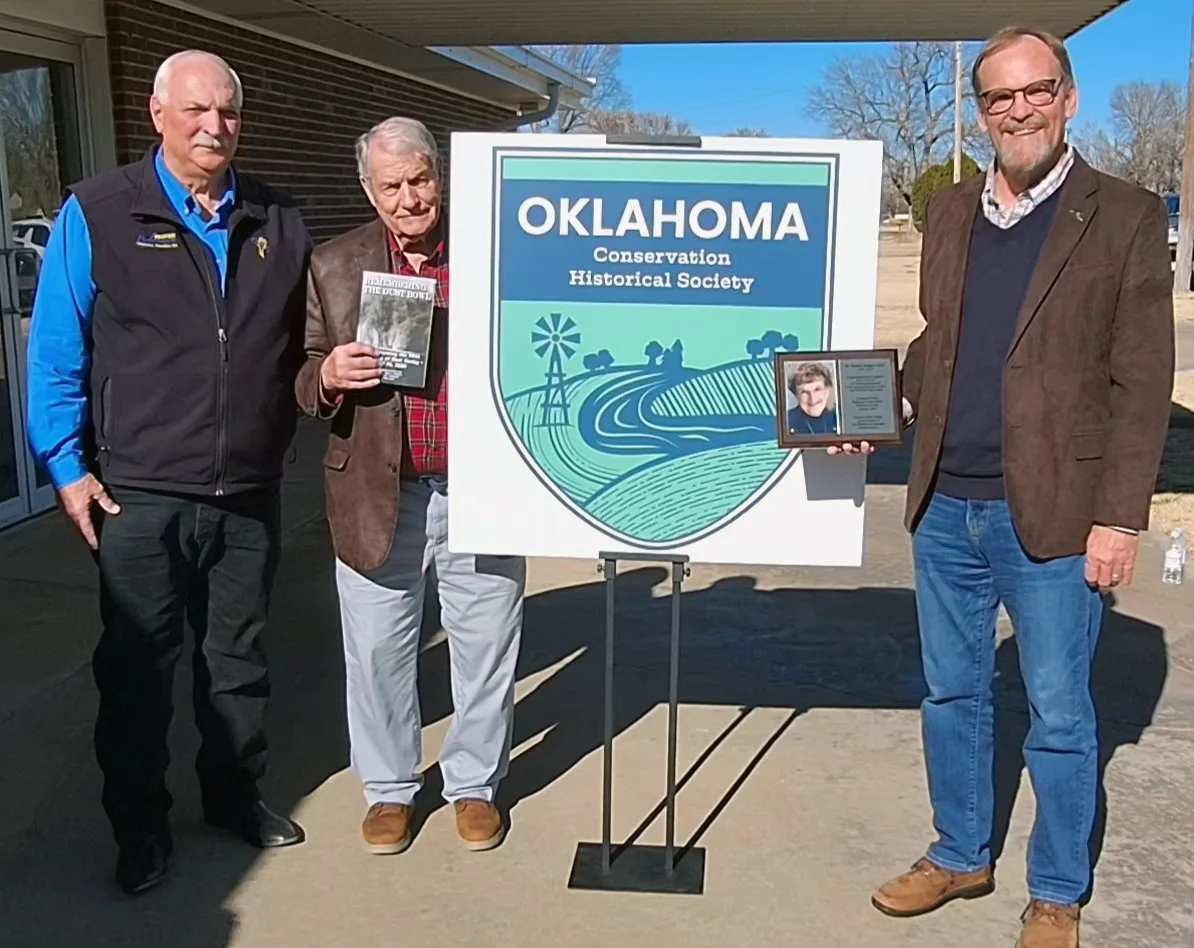
Mark Hodges, Tom Lucas, and Ben Pollard at the event honoring the legacy of Pauline Hodges in Beaver, Oklahoma, January 15, 2026.
On January 15, 2026, Oklahoma Conservation Historical Society members gathered in Beaver, Oklahoma to honor the life and legacy of Pauline Hodges, a founding member of OCHS who passed away in June 2025. In a ceremony led by OCHS President Ben Pollard and board member Tom Lucas, the organization presented plaques to two of Pauline's favorite Beaver County institutions—Forgan Public Schools and the Jones and Plummer Trail Museum—in recognition of her extraordinary contributions to preserving and promoting Oklahoma's conservation history.
BORN INTO HISTORY
Pauline always spoke of her birth with characteristic directness: "I was born at a fine time, 1929, a month before the stock market crash and the beginning of the Great Depression, as well as two years before the beginning of the Dust Bowl, and to wheat farmers in Beaver County."
That simple statement captured the arc of her life. Born to wheat farmers in Beaver County during the worst possible economic moment in American history, Pauline was shaped by the Great Depression and the Dust Bowl—two interconnected catastrophes that tested the resilience of an entire region. She was not merely a survivor of this era; she became one of its most articulate witnesses and most passionate advocates for understanding what it meant.
Growing up in the Panhandle, Pauline attended Forgan High School and then Panhandle State A&M (now Panhandle State University), earning degrees in English and speech. These institutions would remain central to her life's work and her philanthropic interests.
THE EDUCATOR'S CALLING
Pauline's career in education spanned over four decades. She became a public school teacher, earned her doctorate degree, and served as a university professor. She was not merely an educator in the traditional sense; she was an innovator who understood learning at a profound level. Her work as a reading specialist achieved remarkable results, and she became known for never giving up on a student—using incomplete grades as motivation rather than failure, making clear that students would remain in her class "until you pass it or one of us dies of old age, and it won't be me."
Her influence extended far beyond her classroom. She authored books, including a history of Beaver County, and served on the boards of two important Panhandle institutions: the Jones and Plummer Trail Museum in Beaver and the No Man's Land Museum in Goodwell. Through these roles, she worked tirelessly to preserve and promote the history of the region she loved.
THE DUST BOWL DOCUMENTARY
Perhaps Pauline's most visible contribution to conservation history came through her work on Ken Burns' acclaimed documentary "The Dust Bowl." Because of her credentials as an educator, historian, and, most importantly, as a Dust Bowl survivor, Pauline was asked to assist in the research and production of the film.
Her involvement went far beyond a simple interview appearance. Pauline was invited to Burns' headquarters in New Hampshire to review the film and ensure its historical accuracy. She brought not just factual knowledge but lived experience—the memory of what it meant to watch the land disappear, to watch families struggle, to watch communities change.
In 2012, when OETA and the Oklahoma Association of Conservation Districts held six community screenings of the film around the state, Pauline served on the panel discussions that followed each screening. Speaking as a representative of Dust Bowl survivors, she began her remarks with that powerful statement about being born "at a fine time," and then walked audiences through what that time had meant—its hardships, its lessons, its relevance to contemporary conservation challenges.
Pauline became a fixture at conservation events across Oklahoma, providing conservation district directors and employees with a perspective that no textbook could offer. She helped them understand not as an abstract concept but as lived reality—something that determined whether families ate or went hungry, whether communities survived or dispersed, whether the land could be healed.
FOUNDER OF OCHS
When Tom Lucas proposed the idea of forming an organization dedicated to preserving Oklahoma's conservation history, Pauline became its champion. She proudly served on the committee that established the Oklahoma Conservation Historical Society in 2017. For eight years, she served as an advisor to the board, bringing her wisdom, experience, and unwavering commitment to the organization's mission: to collect, preserve, and share Oklahoma's rich conservation history.
LEGACY AND RECOGNITION
In his remarks at the January 15 ceremony, OCHS President Ben Pollard reflected on what Pauline's life meant: "Pauline was a proud daughter of Beaver County, a Dust Bowl survivor, an educator, author, historian and friend of conservation. Because of these credentials, she was asked to assist in the research and production of Ken Burns documentary film on the Dust Bowl."
By presenting plaques to Forgan Public Schools and the Jones and Plummer Trail Museum, OCHS acknowledged the institutions that shaped Pauline and that she, in turn, dedicated herself to serving. These plaques represent more than recognition; they represent a commitment to continuing Pauline's work of preserving the history and values she held dear.
Pauline passed away peacefully in June 2025, leaving behind not just documents, books, and curricula, but a way of thinking about conservation history. She understood that history is not something that happened to other people in other times. It is the ground beneath our feet. It is the land our families have worked. It is the choices our grandparents made that we live with today. And understanding that history is the first step toward making wiser choices for the future.
Her final words in her oral history interview (conducted in 2018 as part of the OCHS/Oklahoma State University Oral History Research Program) captured her enduring spirit: "What I'd like to say is that I made a positive difference in people's lives."
By that measure, Pauline Hodges succeeded beyond measure.
The Oklahoma Conservation Historical Society continues Pauline's legacy through our work to collect, preserve, and share Oklahoma's conservation heritage. Pauline's contributions remind us why this work matters—and why we must continue to tell these stories for future generations.